
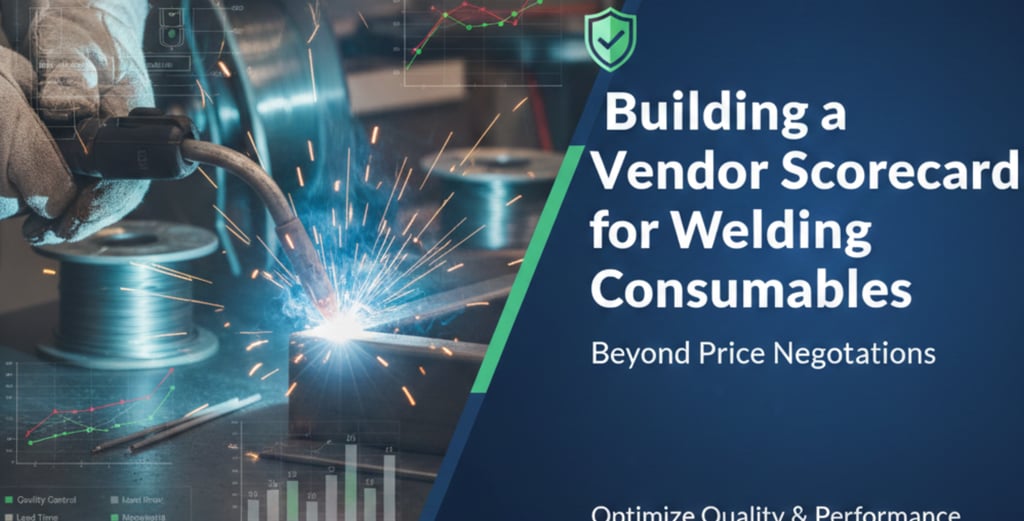
Building a Vendor Scorecard for Welding Consumables: Beyond Price Negotiations
Most procurement teams approach welding consumables sourcing the same way they buy commodity steel: lowest price wins. A 30% discount on wire looks brilliant on an annual savings report.
1/20/20264 min read
The Hidden Cost of a Cost-Per-Kilogram Decision
Most procurement teams approach welding consumables sourcing the same way they buy commodity steel: lowest price wins. A 30% discount on wire looks brilliant on an annual savings report. But when that cheaper filler metal produces porosity defects in a critical fabrication, or when the material chemistry shifts batch-to-batch, and your welders burn through extra wire trying to achieve consistency, the math changes entirely. The procurement victory becomes an operational loss measured in scrap rates, rework hours, and schedule delays.
Welding consumables are not commodities. They are precision inputs that directly influence structural integrity, production velocity, and compliance. Yet procurement teams rarely evaluate them this way. The absence of a structured vendor scorecard leaves procurement exposed to suppliers who compete on price alone, often at the expense of the consistency, technical support, and reliability that manufacturing operations actually need.
Why Price-Only Sourcing Collapses Under Operational Pressure
Sourcing welding consumables on price per kilogram assumes products are interchangeable. They are not. Consider AWS E71T-1C flux-cored wire (FCW), a common structural steel consumable that appears standardized on paper. Yet two suppliers selling E71T-1C under identical specifications may differ fundamentally in shielding gas efficiency, slag chemistry, and arc characteristics. A low-cost supplier might formulate their flux core to function adequately in field conditions, but with less-than-optimal arc stability in cold weather or at high travel speeds. A premium supplier invests in flux chemistry that maintains consistent penetration and deposition rates across temperature ranges and positions.
The discount supplier achieves margin by reducing alloy elements, perhaps lower silicon content for slag fluidity, or tighter tolerances that allow recycled material blending. When your fabrication team deploys E71T-1C for a structural steel bridge connection in winter, or for offshore pipe work exposed to temperature cycling, the cheaper wire's performance gaps emerge. Weld quality becomes inconsistent. Defect rates climb. What appeared as a 15% savings on wire cost becomes a 20% loss when you factor in rework, non-destructive testing delays, and potential customer qualification rejections.
Additionally, ultra-low-cost suppliers often lack the technical resources to support customers. When your production team encounters a weld defect, inconsistent bead profile, spatter clustering, or lack of fusion, they need rapid troubleshooting. The procurement team that selected the vendor based solely on price now faces pressure from the plant floor to solve a problem the supplier cannot address intelligently.
Price negotiations also obscure total cost. Procurement sees a lower unit price; operations sees higher defect rates, longer learning curves for welders switching materials, and potential compliance issues if the filler metal has not been tested against the customer's welding procedure specifications.
Building the Scorecard: Four Pillars of Vendor Evaluation
A structured vendor scorecard transforms the conversation from "What is your per-kilogram price?" to "What total value are you delivering per weld?" The scorecard should evaluate four critical dimensions:
Quality Consistency and Weld Performance.
Track batch-to-batch variation in chemistry and mechanical properties. Request statistical data on tensile strength deviation, elongation ranges, and defect rates. Require suppliers to certify that their material meets not just ISO, AWS or EN standards, but your specific end-use requirements, whether that is impact toughness at sub-zero temperatures, corrosion resistance in coastal environments, or fatigue resistance in dynamic loading. A supplier demonstrating tight quality control deserves premium scoring here, even at a higher purchase price.
Technical Support and Expertise.
Evaluate whether the supplier employs welding engineers, not just sales representatives. Can they troubleshoot defects in real time? A supplier who sits with your production team to optimize parameters and reduce rework hours is reducing your cost-per-specification, even if their invoice price appears higher.
Supply Reliability and Risk Mitigation.
Assess lead times, stock availability, and supply chain resilience. A vendor offering faster delivery or strategic inventory positioning reduces your working capital tied up in safety stock and mitigates the risk of production shutdowns due to stock-outs. In manufacturing, a one-week delay in consumables availability can cascade into multi-week delays in customer shipments. This reliability has concrete financial value.
Cost-Per-Specification Modelling.
Move beyond per-kilogram pricing to cost-per-weld or cost-per-unit-of-output. Calculate the true landed cost: purchase price plus freight, plus quality losses, plus rework hours, plus engineering support time. If a higher-priced supplier reduces your scrap rate by 2%, the scorecard reveals the genuine advantage.
Operationalizing the Scorecard
A practical scorecard weights these four dimensions according to your operational priorities. A fabrication shop serving automotive customers might weight quality and technical support heavily (60% combined) and supply reliability moderately (25%), with cost at 15%. A pipe mill focused on commodity output might reverse the emphasis. The weighting is not universal, it reflects your business model.
Assign each vendor a score (simple 1-10 scale per dimension works well), calculate the weighted total, and use this as your primary decision metric. This shifts negotiations from a binary price conversation to a substantive discussion about value. When a vendor asks for budget approval, they can now justify their proposal with reference to quality consistency, technical support availability, and supply reliability not just a percentage discount.
The Negotiation Advantage
A scored vendor becomes a partner with clearly defined performance expectations. Quarterly reviews against the scorecard keep suppliers aligned to your priorities. Underperformance in any dimension becomes quantifiable and actionable. A vendor whose technical support lags can be flagged and required to improve, or de-prioritized in favor of a competitor. This structured accountability prevents the drift that occurs under informal supplier relationships.
The scorecard also insulates procurement from internal pressure. When a plant manager demands "cheaper wire," procurement can present the scorecard analysis showing that the current vendor's quality consistency and 48-hour delivery capability reduce overall cost-per-weld by 12% versus the cheaper alternative. Data-driven procurement decisions withstand scrutiny.
An additional layer of value emerges when procurement partners with a proven flux cored wire manufacturer in India that invests in continuous process control and application-driven R&D. Such manufacturers do not merely supply consumables; they deliver predictable welding outcomes by maintaining tight control over raw material sourcing, flux formulation, and in-house testing across multiple production batches. This consistency shortens welder learning curves, stabilizes welding procedure qualifications (WPQs), and reduces the risk of customer audits or third-party inspection failures. When evaluated through a vendor scorecard, these capabilities translate directly into lower operational risk and a more resilient production system—benefits that far outweigh marginal differences in per-kilogram pricing.
Conclusion: Redefining Vendor Value
Moving beyond price-per-kilogram is not sentiment; it is financial discipline. A structured vendor scorecard forces procurement to measure what actually matters operationally: consistency, support, reliability, and total cost. The procurement team that adopts this approach will not appear in a savings report for a one-year price cut. They will appear in the P&L as a driver of reduced scrap, faster delivery, and fewer quality crises. That is the true measure of procurement leadership in welding consumables sourcing.


Registered Office
17, Chiman Bagh,
Subhash Marg
Indore (M.P) 452007
India
info@ultrametwelds.com
www.ultrametwelds.com

Plant
D4, Tejas Industrial Park,
Nemawar Road,
Indore (M.P) 452016
India

image from pngtree.com

mig welding wire manufacturer saw flux manufacturer india stainless steel welding wire welding wire suppliers co2 welding wire manufacturers wire welding with argon gas welding manufacturing companies mig welding wire mig wire supplier flux cored wire manufacturerhardfacing welding wirewelding stainless steel with flux core wireflux cored wire suppliersflux cored stainless mig wireflux cored wire manufacturer in indiaflux cored wire manufacturershardfacing welding wirehardfacing flux cored wire
Copyright ©2026 Ultramet Welds Pvt Ltd. All Rights Reserved