
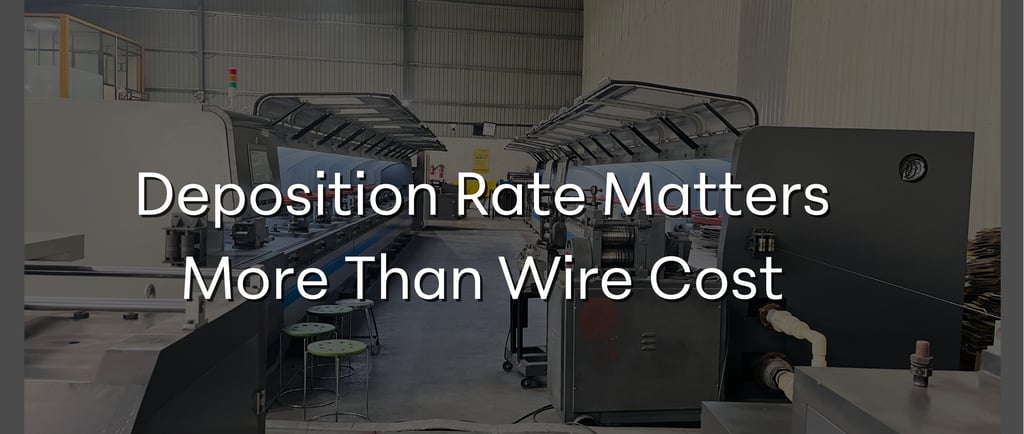
Deposition Rate Matters More Than Wire Cost
The problem isn't a lack of understanding, it's a flaw in how the welding industry calculates costs. Shop managers compare wire prices per kilogram, a single variable that obscures multiple variables determining total cost of ownership. This is equivalent to buying an engine based on
1/30/20265 min read
The Myth of Cheap Wire
Every fabrication shop receives a call from a wire distributor or supplier offering "premium" flux-cored wire at lower cost than the ones recommended. The pitch is simple: "Same performance, better margin. Switch now."The ones that fall for the gimmick often regret it within weeks.The problem isn't a lack of understanding, it's a flaw in how the welding industry calculates costs. Shop managers compare wire prices per kilogram, a single variable that obscures multiple variables determining total cost of ownership. This is equivalent to buying an engine based on fuel tank capacity while ignoring fuel consumption rate.
Why Cost Per Kilogram Misleads
The decision appears obvious: choose Wire B and save 10% on consumables. But this comparison ignores the variables that determine total cost.
The Variables That Determine Actual Welding Cost
1. Deposition Efficiency (Most Important)
Deposition efficiency is the percentage of wire that actually becomes
weld metal. The remainder is lost to:
Spatter (droplets ejected from the pool)
Stub loss (unusable end of the consumable)
Vaporization (flux losses during arc)
Wire feed inconsistency (improperly fused wire)
A wire with 85% efficiency wastes 15% of its mass. A wire with 70% efficiency wastes 30%, double the waste. If you purchase 1 ton of each:
Premium wire (85% efficiency): 850 kgs welded, 150 kgs wasted
Standard wire (70% efficiency): 700 kgs welded, 300 kgs wasted
The standard wire wastes 100 additional kgs of wire that must be purchased again.
2. Deposition Rate (Metal Deposited Per Hour)
A premium flux-cored wire rated for 50-70 amps typically deposits metal at 3.5-5.5 kgs per hour, depending on parameters. Standard wire might deposit only 2.5-4 kgs per hour due to:
Less stable arc requiring lower travel speed
Greater spatter losses
More inconsistent wire feed
Parameters that require frequent adjustment
If a fabrication shop needs to deposit 500 kgs of weld metal daily:
Premium Wire:
Deposition rate: 10 kgs/hour
Labour hours required: 500 ÷ 10 = 50 hours
Standard Wire:
Deposition rate: 7 kgs/hour
Labour hours required: 500 ÷ 7 = 71.4 hours
Additional labour hours for standard wire: 21.4 hours daily = 470 hours monthly
3. Operating Factor (Actual Arc Time vs. Total Time)
Operating factor represents the percentage of a shift actually spent welding versus spent on setup, positioning, cleanup, and adjustments. Operating factors typically range from 40-80% depending on:
Product design (simple vs. complex geometry)
Welder experience and fatigue
Equipment reliability
Weld parameter stability
Slag removal difficulty
Premium wire with stable arc and easy slag removal enables higher operating factors:
Higher operating factor means more productive output from the same labour budget.
4. Rework and Defect Rate
Standard wire produces more weld defects: porosity, incomplete fusion, excessive spatter, slag inclusions. Each defect requires rework, doubling the labour invested in that joint.
Premium wire: 2-3% rework rate
Standard wire: 6-8% rework rate
On a fabrication job requiring 200 linear feet of weld:
The Complete Cost Comparison
For a typical fabrication operation producing 2,000 linear feet of structural weld monthly:
Premium Flux-Cored Wire
Wire consumption: 180 kgs/month
Cost per kg: ₹123
Wire material cost: ₹22,140/month
Deposition efficiency: 82%
Wasted wire (18%): 32.4 kgs
Effective cost per deposited kg: ₹22,140 /(180 * 0.82) = ₹150/kg
Standard Flux-Cored Wire
Wire consumption: 240 kgs/month (33% more due to lower efficiency)
Cost per kg: ₹112
Wire material cost: ₹ 26,880/month
Deposition efficiency: 72%
Wasted wire (28%): 67.2 kgs
Effective cost per deposited kg: ₹ 26,880/ (240*0.72) = ₹155.55/kg
On pure consumables, standard wire is costlier (₹155.55 vs. ₹150 per deposited kg). But when we add labour cost, which dominates total cost:
Labour and Overhead Cost Analysis
Premium wire enables 55% operating factor
Standard wire operates at 42% operating factor
Labour rate: ₹110/hour (fully loaded)
For 2,000 linear feet of weld monthly:
Premium Wire:
Labour hours: 2,000 feet/ 4.5 kg/hour / 0.55 operating factor / 8 hours/day = 101 labour hours
Labour cost: 101*₹110 = ₹11,110
Standard Wire:
Labour hours: 2,000 feet / 3.2 kgs/hour / 0.42 operating factor / 8 hours/day = 186 labour hours
Labour cost: 186 * ₹110 = ₹20,460
Labour difference: ₹9,350 monthly, or ₹1,12,200 annually.
And when combine with rework costs that difference is greater.
The Formula for Cost Per Foot of Weld
Instead of comparing price per kg, fabrication shops should calculate cost per foot of weld, which captures all relevant variables
Cost Per Foot = [(Consumable Cost) + (Labour Cost) + (Rework Cost)] / (Linear Feet Produced)
The Industry's Dirty Secret
Major fabrication shops in Germany, Japan, and increasingly in India's shipbuilding sector don't negotiate on consumable cost. They negotiate on total cost per part. A shop manager might pay 25% more for wire but demand:
Guaranteed delivery schedules
Technical support for parameter optimization
Quality certifications
Consistency that reduces rework
The supplier's profit comes from volume, not margin, because the customer produces higher volume with fewer labour hours and defects.
Implementing Cost-Per-Foot Analysis in Your Shop
Step 1: Establish Baseline
For one month, measure:
Total wire purchased (kgs)
Total labour hours spent welding
Total linear feet of weld produced
Rework hours and cost
Repair jobs due to slag inclusions or defects
Step 2: Calculate Current Cost Per Foot
Consumable cost: (Total kgs × cost per kg) ÷ feet
Labour cost: (Total welding hours × labour rate) ÷ feet
Rework cost: (Rework hours × labour rate) ÷ feet
Total cost per foot
Step 3: Pilot Premium Wire
Select equivalent premium wire (same diameter, position rating)
Run 2-week pilot with 10% of welders
Measure improvements in:
Slag removal time reduction
Rework rate decrease
Operating factor increase
Labour hours per foot of weld
Step 4: Extrapolate ROI
If pilot shows 20% reduction in labour hours per foot
On 2,000 feet monthly production: 40 hours saved × 110/hour labour cost
Annual savings: $21,600 at ~$300 incremental consumable cost annually
ROI: 72:1
Real Industry Example: Indian Shipbuilding
India's major shipyards producing vessels for naval and commercial customers extensively use premium flux-cored wire. Why? Because:
Customer contracts specify quality compliance (higher quality standards)
Defects discovered during final inspection delay delivery,
Rework on structural joints is exponentially more expensive than on plate fabrication
Premium wire consistently meets specifications, reducing inspection iterations
A single shipyard might save ₹9 cr –₹20 cr annually by switching to premium consumables through higher throughput and eliminated rework, despite doubling consumable costs.
Strategic Takeaway
When evaluating welding wire, never compare cost per kilogram. Calculate cost per foot of weld using complete variables: material, labour, and rework. Premium flux-cored wire almost universally delivers lower cost per foot while simultaneously improving delivery performance and quality compliance.
The shop that understands this principle becomes the shop that wins contracts from customers who care about delivery, quality, and total value, which is increasingly all of them.
Conclusion:
Flux-cored welding has become a preferred choice for many industries due to its efficiency, strength, and versatility, making the role of reliable flux cored wire suppliers more important than ever. High-quality flux-cored wire ensures consistent weld quality, better penetration, reduced spatter, and improved productivity across applications such as construction, shipbuilding, automotive, and heavy fabrication. Trusted flux cored wire suppliers not only provide superior materials but also offer technical support, product guidance, and industry-specific solutions that help businesses achieve stronger, cleaner, and more durable welds while maintaining cost-effectiveness and safety standards.
Registered Office
17, Chiman Bagh,
Subhash Marg
Indore (M.P) 452007
India
info@ultrametwelds.com
www.ultrametwelds.com

Plant
D4, Tejas Industrial Park,
Nemawar Road,
Indore (M.P) 452016
India

image from pngtree.com

mig welding wire manufacturer saw flux manufacturer india stainless steel welding wire welding wire suppliers co2 welding wire manufacturers wire welding with argon gas welding manufacturing companies mig welding wire mig wire supplier flux cored wire manufacturerhardfacing welding wirewelding stainless steel with flux core wireflux cored wire suppliersflux cored stainless mig wireflux cored wire manufacturer in indiaflux cored wire manufacturershardfacing welding wirehardfacing flux cored wire
Copyright ©2026 Ultramet Welds Pvt Ltd. All Rights Reserved