
Designing Weld Procedures for Harsh Marine Conditions: Why Flux Cored Wire Wins on the Slipway
A shipyard slipway is one of the most demanding welding environments on earth. Salt-laden air, unpredictable wind, plate surfaces that haven't been pre-cleaned to laboratory standards, and welders working overhead in cramped double-bottom tanks or high on hull sections in all weather this is the reality of ship fabrication and repair in Indian ports like Kochi, Visakhapatnam, Mumbai, and Surat.
4/16/20264 min read
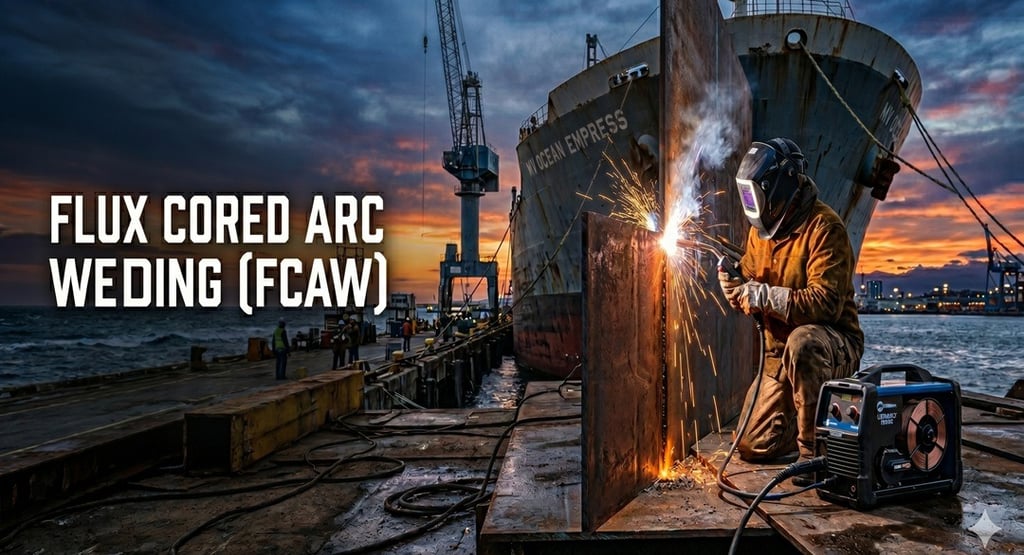
A shipyard slipway is one of the most demanding welding environments on earth. Salt-laden air, unpredictable wind, plate surfaces that haven't been pre-cleaned to laboratory standards, and welders working overhead in cramped double-bottom tanks or high on hull sections in all weather this is the reality of ship fabrication and repair in Indian ports like Kochi, Visakhapatnam, Mumbai, and Surat.
In this environment, not all welding processes perform equally. Flux Cored Arc Welding (FCAW), particularly when specified with the right wire grade and shielding configuration, consistently outperforms SMAW (stick welding) and GMAW (MIG) under harsh marine conditions. Here's why, and how to write weld procedures that capture the full advantage.
The Marine Welding Challenge, Defined
Before specifying any process or consumable, the welding engineer must understand the conditions that make marine fabrication uniquely difficult:
Wind and drafts
On open berths and dry docks disrupt shielding gas coverage in GMAW, causing porosity and lack of fusion
High ambient humidity and salt atmosphere
Accelerate moisture pickup in electrodes and flux, raising hydrogen risk in welds
Less-than-ideal fit-up
In ship blocks due to cumulative plate distortion and positional constraints
Restricted access and confined spaces
Tanks, bilges, cofferdams requiring all-position welding with minimal torch manipulation room
Thick plate
(10–50mm) Hull construction demanding multi-pass, high-deposition procedures to hit productivity targets
FCAW addresses each of these challenges with a combination of process physics and consumable chemistry that no single competing process matches completely.
Self-Shielded FCAW: The Outdoor Workhorse
Self-shielded FCAW (FCAW-S) using Flux Cored Wire generates its own shielding atmosphere from the flux core; no external gas cylinder is required. This makes it genuinely wind-resistant, as there is no gas cone to disrupt. In exposed yard conditions, crosswinds of 15–30 km/h that would cause immediate porosity in GMAW have minimal effect on a properly run FCAW-S pass.
For tack welding, fit-up correction runs, and in-situ hull repair in exposed berths, FCAW-S is the practical default. It is also highly portable; the absence of gas equipment simplifies setup significantly in access-constrained locations.
Procedure note
FCAW-S requires careful attention to polarity (DCEN for most rutile self-shielded types) and contact tip-to-work distance. Maintain stick-out within the manufacturer's recommended range; excessive stick-out increases fume and reduces arc stability. Ultramet technical datasheets include verified stick-out windows for each grade.
Gas-Shielded FCAW: Precision Fusion for Structural Hull Joints
Where controlled ventilation is achievable inside fabrication halls, under tenting, or in purpose-built block assembly areas, gas-shielded FCAW (FCAW-G) with 75/25 Ar/CO₂ or 100% CO₂ shielding delivers the best combination of bead quality, mechanical properties, and deposition rate for structural hull joints.
Key advantages for marine structural welding:
All-position capability
Vertical-up and overhead welds on hull frames and longitudinals are achievable with correct wire selection (typically E71T-1C or E81T1-Ni1, depending on grade requirement)
High deposition in flat and horizontal
Panel line productivity for deck plates and shell plating is significantly higher than SMAW
Reduced sensitivity to plate contamination
Modern FCAW flux formulations are more tolerant of mill scale, light rust, and moisture on the plate surface compared to GMAW wire. This directly reduces pre-cleaning labour on tight delivery schedules.
Consistent bead profile
Critical for multi-pass groove welds where interpass temperature and bead geometry affect final joint integrity
Welding Position Strategy: Hull Sections in Practice
Ship construction involves every welding position often within the same joint sequence. Here is how to approach position-specific procedure design with FCAW:
Flat (1G/1F) Shell plating and deck panels:
Maximum productivity mode. Run higher wire feed speeds and wider weave beads for fast fill. Deposition rates of 4–8 kg/hr achievable. Use E71T-1C for normal strength steel (AH36, DH36) and E81T1-Ni1 for higher-strength grades.
Horizontal (2F/2G) Longitudinal fillet welds on frames
Single-pass fillets up to 8mm leg length achievable in 2F position. Control heat input carefully to avoid undercut on the vertical plate face.
Vertical-up (3G/3F) Hull girder web plates and transverse frames:
Use lower wire feed settings and narrower weave or stringer bead technique. Slag control is critical ensure each pass is fully cleaned before depositing the next. Select a wire with a fast-freezing slag system designed for positional welding.
Overhead (4G/4F) Tank top and underside hull structure
Most demanding position. Use the lowest practical heat input, short arc technique, and ensure adequate ventilation. Self-shielded wire is often preferred here for its flat, fast-freezing slag.
Weld Procedure Qualification: Class Society Requirements
All structural welds on classification society-surveyed vessels (DNV, Lloyd's Register, Bureau Veritas, IRS) require qualified Welding Procedure Specifications (WPS) backed by Welding Procedure Qualification Records (WPQR). For FCAW, this means:
Wire classification to AWS A5.20 (carbon steel) or A5.29 (low-alloy)
Shielding gas composition locked in the WPS (gas-shielded variants only)
Preheat and interpass temperature requirements per the applicable standard (typically EN ISO 13916 or AWS D1.1/IACS requirements)
Impact testing (CVN) at the specified temperature — typically 0°C or −20°C for normal and higher-strength marine grades
Ultramet's FCAW wires come with full mill test certificates, wire classification data, and technical guidance for WPQR development reducing qualification time and engineering effort for your yard.
Maintaining Bead Integrity in Variable Weather
One question marine welding engineers frequently raise: what happens to weld quality when ambient conditions shift mid-shift? A morning fog or afternoon sea breeze can change effective humidity at the plate surface significantly.
Best practice protocols for weather-resilient FCAW on the slipway:
Wire storage: Keep open spools in heated wire storage ovens or sealed with desiccant. Even gas-shielded FCAW wire is susceptible to moisture pickup on the flux core in high-humidity coastal environments.
Preheat maintenance: Use induction or flame preheat on plate thicknesses above 20mm. Maintain preheat throughout the joint sequence, not just at the start.
Wind breaks: For FCAW-G, deploy portable welding screens to reduce effective wind speed at the weld point below 8 km/h (the practical threshold for shielding gas disruption).
Interpass temperature monitoring: Use contact thermometers or thermal sticks at every pass in multi-pass joints.
Why Shipyards Choose Ultramet
Ultramet FCAW wires are engineered for exactly these conditions—consistent arc behaviour from root pass to cap, reliable mechanical properties across positions, and flux formulations that give welders meaningful tolerance on fit-up and surface condition. As trusted flux cored wire suppliers, our technical team is available to co-develop WPQR packages and process recommendations for your specific vessel class and steel grade.
Designing a weld procedure for your next vessel project?
Contact Ultramet Welds for a free technical consultation and wire recommendation.
Wire samples available for qualification trials.
Registered Office
17, Chiman Bagh,
Subhash Marg
Indore (M.P) 452007
India
info@ultrametwelds.com
www.ultrametwelds.com

Plant
D4, Tejas Industrial Park,
Nemawar Road,
Indore (M.P) 452016
India

image from pngtree.com

mig welding wire manufacturer saw flux manufacturer india stainless steel welding wire welding wire suppliers co2 welding wire manufacturers wire welding with argon gas welding manufacturing companies mig welding wire mig wire supplier flux cored wire manufacturerhardfacing welding wirewelding stainless steel with flux core wireflux cored wire suppliersflux cored stainless mig wireflux cored wire manufacturer in indiaflux cored wire manufacturershardfacing welding wirehardfacing flux cored wire
Copyright ©2026 Ultramet Welds Pvt Ltd. All Rights Reserved