
FCAW Versus GMAW in Automated Cells: What Plant Leaders Need to Know
In many plants, automation decisions begin with the robot and end with disappointment. The hardware is capable, yet the cell never reaches its expected throughput, quality, or uptime. The root cause is often simple. The process in the torch was chosen by habit rather than by design.
3/20/20266 min read
In many plants, automation decisions begin with the robot and end with disappointment. The hardware is capable, yet the cell never reaches its expected throughput, quality, or uptime. The root cause is often simple. The process in the torch was chosen by habit rather than by design. For a plant head or production manager, the fundamental question is not only which robot to install, but whether flux cored arc welding or gas metal arc welding is the right foundation for that automated cell.
Flux cored arc welding and gas metal arc welding share power sources and wire feeders, but they are different processes. FCAW uses a tubular flux cored wire in the core that generates shielding and slag, while GMAW relies on a solid wire and external shielding gas. These differences change how the arc behaves, how the weld pool freezes, and how the joint responds to imperfect fit up and less than ideal conditions on the shop floor. As production speeds increase and components become more demanding, those differences translate directly into cost and risk. This article is not about defending one process and dismissing the other. Both have a place in a modern automated plant. The objective is to give leaders a practical way to decide where FCAW delivers superior productivity and robustness, and where GMAW remains the better choice, so that capital investments are aligned with the realities of the workpiece and the environment.
The Strategic Nature of the Process Choice
In an automated or mechanized line, the process choice is a strategic decision because it sets the limits of what the cell can do for its entire life. Robots, positioners, and fixtures can be reprogrammed, but the underlying process characteristics remain. FCAW and GMAW can both be automated, yet they respond very differently when you ask for higher travel speeds, thicker sections, or demanding positions.
GMAW has become the default in many automated applications because it is clean, produces minimal slag, and works very well for flat and horizontal joints on clean, well prepared material. By contrast, FCAW is often associated with manual heavy fabrication. That view is outdated. Modern flux cored wires are engineered specifically for robotic and mechanized FCAW, with stable arcs, controlled slag behavior, and deposition rates that are difficult to match with solid wire.
For senior decision makers, the question is not which process is more popular in the industry. The question is which process is best aligned with the joint designs, part geometries, and environmental constraints that exist in their own plant. That requires a closer look at penetration and deposition, positional capability, and tolerance to real shop conditions.
Penetration, Deposition Rate, and Cycle Time
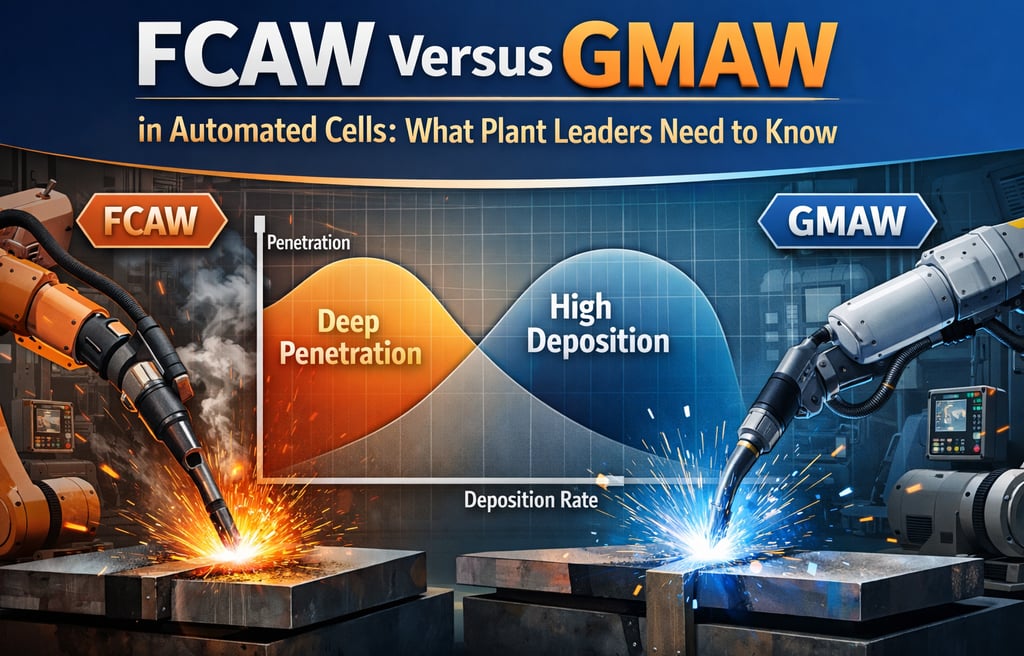
Any automated welding cell lives or dies by its ability to move metal into the joint quickly and correctly. Deposition rate and penetration quality are therefore central to process selection. FCAW generally achieves higher deposition rates than GMAW at similar current levels because the flux core and transfer characteristics support the use of higher effective heat input. This is especially valuable in thick materials, large fillets, and multi pass groove welds where weld metal volume dominates the cycle time.
Penetration behavior is also different. With correctly selected flux cored wire and parameters, FCAW tends to produce deep, consistent fusion into the base metal. The slag system and arc concentration help the weld pool reach and bond to the root, even when gaps and alignment are not perfect. GMAW can deliver excellent penetration on properly prepared joints, but becomes more sensitive to root openings and fit up variation as travel speed increases. That sensitivity can show up as lack of fusion or intermittent defects that are hard to detect visually, creating rework and quality risk.
In practical terms, FCAW is often the stronger candidate for automated welding of heavy structural members, construction equipment frames, trailers, and power plant components, where each joint requires substantial weld metal and full fusion is non negotiable. GMAW remains highly competitive on thinner materials, automotive body structures, and other applications with precise joint preparation, low weld volume, and a premium on very high travel speed and clean surface appearance.
Positional Capability and Real Shop Constraints
Not every robot welds in the flat position on an ideal fixture. In many plants, part geometry, building layout, and production flow force robots and mechanized systems to handle vertical, overhead, or mixed position welding. FCAW is fundamentally suited to this challenge. The slag system and controlled solidification make it easier to maintain a stable weld pool in vertical up or overhead positions without excessive sagging, undercut, or irregular bead shape.
GMAW can be applied in multiple positions, but as current and travel speed rise it becomes more difficult to control the puddle in anything other than flat and horizontal orientations. That often pushes plants toward more complex and expensive fixturing that constantly repositions the part so the robot can weld flat. This can increase capital cost and reduce flexibility when product designs or variants change.
Environmental reality also matters. FCAW, particularly in gas shielded variants, is more tolerant of moderate drafts, mill scale, and minor surface contamination because the flux contributes to both shielding and slag formation. GMAW depends entirely on the integrity of the external shielding gas envelope. Air movement from ventilation, adjacent processes, or open doors can disturb that envelope and lead quickly to porosity and incomplete fusion. In cells that are not fully enclosed or that share space with other operations, that sensitivity can erode the theoretical advantages of GMAW.
Quality, Defect Modes, and Monitoring
From a quality standpoint, both FCAW and GMAW can produce welds that satisfy stringent codes and customer specifications when they are engineered and controlled correctly. The difference for automated cells lies in the dominant defect mechanisms and how easily they can be managed in day to day production. With FCAW, the primary concerns are usually slag inclusions, excessive spatter, and occasional porosity if parameters do not match the wire or if slag removal is rushed between passes. These defects are relatively straightforward to control when parameter windows, travel techniques, and interpass cleaning practices are clearly defined and followed. With GMAW, typical automated defects include lack of fusion, undercut, and gas related porosity, especially when shielding conditions or stickout and torch angles are not tightly controlled. These defects can be more insidious because they often occur intermittently and may not be obvious from surface appearance alone. That can increase reliance on inspection and non destructive testing to confirm quality.
Modern monitoring tools help both processes. Connected power sources can track voltage, current, wire feed speed, and travel speed and flag deviations from approved procedures. For FCAW, this data helps maintain the window where slag forms and releases correctly. For GMAW, it helps ensure that the arc remains stable and that heat input is sufficient to avoid lack of fusion. The key point for leaders is that FCAW tends to be more tolerant of realistic variation in joint condition once it is set up correctly, while GMAW demands a more tightly controlled environment to maintain extremely low defect rates at high speed.
A Practical Decision Framework for Leaders
Plant heads and production managers do not need to become process theorists, but they do need a simple framework to guide process selection in automated and mechanized applications. The following questions can anchor that discussion with welding engineers and automation teams:
What is the typical thickness and weld metal volume for the joints in this cell
If welds are large and multi pass, FCAW often offers a better balance of deposition rate and quality.In which positions will the robot or mechanized system realistically weld
If vertical and overhead positions cannot be fully eliminated by fixturing, FCAW usually provides more controllable behavior.How stable and clean is the environment around the cell
If drafts, shared floor space, or variable surface condition are expected, FCAW tends to be more forgiving than GMAW.How consistent is the joint preparation and product mix
If the line handles thin material, tight tolerances, and stable, high volume work, GMAW can be extremely efficient.What internal and external expertise is available
If you can invest in good FCAW procedure development and operator training, the process will reward that investment with robustness and reduced firefighting.
Many best in class plants do not choose a single process. They deliberately deploy FCAW where robustness, penetration, and positional flexibility are required, and GMAW where cleanliness, low spatter, and very high speed on thin material are the priority. That kind of intentional process mapping turns automation into a strategic capability rather than a collection of isolated projects.
Strategic Implications and the Role of the Consumable Partner
The decision between FCAW and GMAW influences more than weld appearance. It shapes capital productivity, energy use, rework rates, and the ease with which capacity can be scaled when demand grows. A cell that looks efficient in a proposal but is constrained by a poorly matched process will quietly consume management attention and engineering time for years.
By contrast, a cell built on a process that fits the joint family and the environment becomes a reliable asset. It can be replicated across lines or sites with confidence and can absorb reasonable variation in material and fit up without constant intervention. That is the level of reliability that executives expect from automation, and it is achievable when process selection is treated as a strategic design decision, not an afterthought.
When you reach that point of clarity, it is time to select a partner that can match your ambition. Once you have decided, contact Ultramet Welds for flux cored wire or MIG wire. Our products are engineered to give automated cells the stability, penetration, and consistency they need, so from the first arc to full scale production, you know you are covered.
Registered Office
17, Chiman Bagh,
Subhash Marg
Indore (M.P) 452007
India
info@ultrametwelds.com
www.ultrametwelds.com

Plant
D4, Tejas Industrial Park,
Nemawar Road,
Indore (M.P) 452016
India

image from pngtree.com

mig welding wire manufacturer saw flux manufacturer india stainless steel welding wire welding wire suppliers co2 welding wire manufacturers wire welding with argon gas welding manufacturing companies mig welding wire mig wire supplier flux cored wire manufacturerhardfacing welding wirewelding stainless steel with flux core wireflux cored wire suppliersflux cored stainless mig wireflux cored wire manufacturer in indiaflux cored wire manufacturershardfacing welding wirehardfacing flux cored wire
Copyright ©2026 Ultramet Welds Pvt Ltd. All Rights Reserved