
Flux Cored Arc Welding: The Future of Smart Fabrication
Explore how Flux Cored Arc Welding with automation and IoT improves fabrication efficiency, weld quality, and productivity across industries.
3/10/20262 min read
Fabrication worldwide grapples with throughput demands, welder gaps, and stringent joint integrity. Robotic systems propel growth to 2035 in automotive, shipbuilding, energy, and infrastructure. Flux cored arc welding emerges as the optimal process for automated cells, offering slag protected stability and high deposition unmatched by solid wire GMAW.
Flux Cored Arc Welding in Automation
FCAW excels in robotics via its flux core, generating shielding gas and slag for deep penetration, all position work, and minimal defects at scale. Distinct from GMAW, FCAW handles dirty steels and windy conditions, with self shielded variants eliminating external gas needs.
Automated FCAW boosts deposition two to three times, cuts spatter and cleanup 30 to 50 percent, and sustains uniform beads via stable metal transfer. Critical for long seams in cells and gantries. Production gains 40 percent while labor drops 25 percent, reshaping fab economics.
IoT Power in FCAW Processes
IoT captures FCAW parameters, voltage, wire speed, slag coverage, heat input, live, hitting 98 percent yields. Slag analysis and arc data enable drift detection, predictive tweaks, and envelope control.
In power hardfacing, IoT monitored FCAW doubles component life, trims downtime 20 percent. Data libraries standardize FCAW globally, scaling from pilot to enterprise.
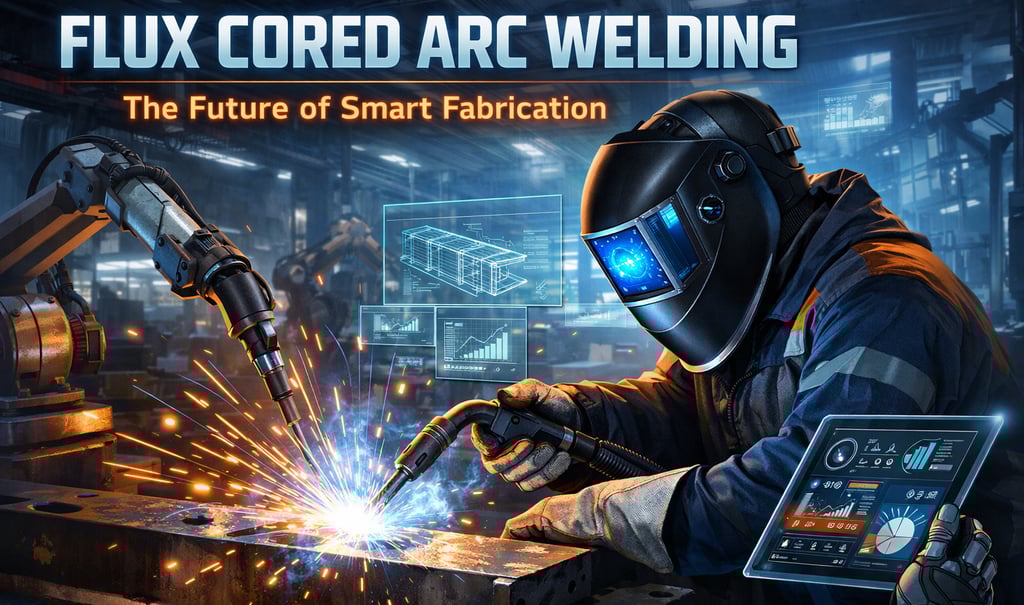
[Image Placeholder: Robotic FCAW cell with slag removal, IoT dashboard.]
FCAW Automation Across Sectors
Automated FCAW transforms:
Automotive: Robotic flux cored for chassis and exhaust, slag aiding alloy protection.
Shipbuilding: Gantry FCAW on plates, high deposition for hulls.
Power: FCAW hardfacing with slag control for turbines and boilers.
Yields superior uptime, quality, savings in FCAW robotics.
Global Strategies for FCAW Leaders
5.3 percent robotics rise to 2035 favors FCAW adopters with 15 to 20 percent edges. Strategies:
Audit FCAW streams: ID robotic priorities.
Optimize parameters: Target 20 percent deposition lifts.
KPI focus: Yield, slag quality, consumption.
Partner wisely: Select FCAW tuned consumables and expertise.
FCAW Decade Ahead: Scalable Precision
FCAW plus automation and monitoring fuels resilient chains. Providers like Ultramet Welds enable with FCAW optimized flux cored wire.
Lead: Assess your FCAW automation path today.
Conclusion
Flux Cored Arc Welding (FCAW) is becoming a key technology for the future of modern fabrication. With its high deposition rates, ability to work in challenging conditions, and compatibility with robotic systems, FCAW supports faster and more reliable production. When combined with automation and IoT-based monitoring, it helps manufacturers improve weld quality, reduce downtime, and increase overall efficiency. As industries move toward smarter and data-driven manufacturing, FCAW will play a vital role in building more productive and resilient fabrication processes.


Get in Touch with Ultramet Welds
If you’re looking for high-quality hardfacing welding wire or hardfacing flux-cored wire, Ultramet Welds offers the right solution backed by technical expertise and proven results.
Registered Office
17, Chiman Bagh,
Subhash Marg
Indore (M.P) 452007
India
info@ultrametwelds.com
www.ultrametwelds.com

Plant
D4, Tejas Industrial Park,
Nemawar Road,
Indore (M.P) 452016
India

image from pngtree.com

mig welding wire manufacturer saw flux manufacturer india stainless steel welding wire welding wire suppliers co2 welding wire manufacturers wire welding with argon gas welding manufacturing companies mig welding wire mig wire supplier flux cored wire manufacturerhardfacing welding wirewelding stainless steel with flux core wireflux cored wire suppliersflux cored stainless mig wireflux cored wire manufacturer in indiaflux cored wire manufacturershardfacing welding wirehardfacing flux cored wire
Copyright ©2026 Ultramet Welds Pvt Ltd. All Rights Reserved