
How Digitalization is Changing Welding Operations Globally | Ultramet Welds
Digitalization is transforming welding worldwide. See how AI, and data-driven quality control are reshaping operations, and why a dependable welding wire manufacturer in India still matters.
7/10/20263 min read
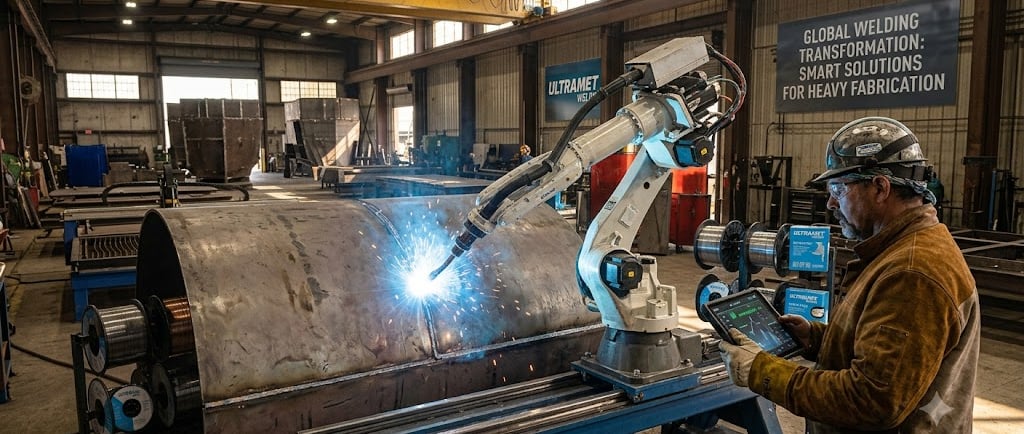
The Global Shift Toward Smart Welding
Welding, historically dependent on manual skill and experience, is undergoing a fundamental transformation worldwide. The integration of digital tools, sensors, and AI-driven systems is turning welding from a craft-based process into a data-driven, measurable operation.
This shift is not confined to a single region manufacturers across Europe, North America, Asia, and welding wire manufacturers in India are adopting digital welding technologies to meet rising quality expectations and productivity demands.
The Problem: Traditional Welding is Data-Blind
For decades, welding operations have generated valuable process data, including current fluctuations, arc behavior, and temperature variations, that went largely unrecorded and unused. This has historically resulted in:
● Reactive rather than predictive maintenance
● Limited visibility into root causes of defects
● Inconsistent quality across large production batches
● Missed opportunities for process optimization
Without digital tracking, critical process information effectively became a data graveyard generated but never analyzed.
The Global Market Momentum
The scale of this transformation is reflected in market growth. The global robotic welding market was valued at approximately USD 5.42 billion in 2020 and is projected to reach USD 9.76 billion by 2028, growing at a CAGR of 7.7%. Separately, the broader robotics welding market was valued at USD 7.8 billion in 2022, with projections of over 10% CAGR through 2032.
In the United States alone, the American Welding Society (AWS) reported a more than 20% year-over-year increase in installed robotic welding systems, signaling accelerated automation adoption.
Key Digital Technologies Reshaping Welding
1. Sensor-Based Real-Time Monitoring
Modern welding systems now capture live data on current, voltage, and temperature, enabling immediate detection of anomalies during the welding process.
2. AI and Machine Learning Integration
AI and ML algorithms are increasingly used to predict weld outcomes, automate quality checks, and reduce dependency on manual inspection methods, which are often slow and costly.
3. Predictive Maintenance
By analyzing equipment performance data, manufacturers can shift from reactive repairs to predictive maintenance, reducing unplanned downtime.
4. Digital Quality Control Systems
Software platforms now allow real-time verification of weld compliance against welding procedure specifications (WPS), which is especially critical in demanding applications like subsea welding. This is particularly relevant for consumables such as SAW welding wire and flux cored wire, where digital verification adds another layer of quality assurance in critical fabrication environments.
5. Process Intelligence Platforms
Advanced data processing tools convert raw welding data into actionable insights, helping identify recurring defect patterns and optimize parameters proactively.
Measurable Business Impact
Digitalization isn't just a technological upgrade it delivers tangible operational value. According to McKinsey research cited by industry sources, digitizing information-intensive processes can cut costs by up to 90% and significantly reduce turnaround times.
Beyond cost savings, companies report improved cross-team collaboration, better user experience in shop-floor operations, and the breakdown of traditional organizational silos through connected welding systems.
Global Industry Trends
Automation & Robotics: Increased speed, precision, and consistency in welding
AI/ML Defect Detection: Faster, more accurate inspection than manual NDT methods
IoT-Enabled Equipment: Real-time monitoring of welding parameters
Predictive Maintenance: Reduced downtime and equipment failures
Digital Traceability: Improved compliance and audit readiness
Impact on Workforce and Skills
Contrary to concerns about job displacement, digitalization is reshaping welder roles rather than eliminating them. The demand is shifting toward skilled professionals who can program, monitor, and maintain automated and digitally connected welding systems. New career paths such as robotic welding technicians and welding engineers are emerging globally as a direct result of this transformation.
Industry Perspective
Across the global welding ecosystem, equipment manufacturers and software providers are increasingly focused on connected, intelligent welding solutions that combine automation with real-time data insights. This same shift toward consistency and data-backed performance also elevates the importance of reliable consumable quality, an area where suppliers such as Ultramet Welds, a welding wire manufacturer in India, align with the broader push toward predictable, high-performance welding outcomes. As digital monitoring becomes more widespread, welding wire suppliers and welding wire manufacturers alike are increasingly expected to demonstrate consistent quality metrics batch after batch.
The Road Ahead
As global manufacturing continues to prioritize efficiency, compliance, and quality assurance, digitalization is expected to become a standard operational layer in welding much like automation itself did in previous decades. Industries such as shipbuilding, energy, and heavy fabrication are likely to lead this adoption due to their stringent quality and safety requirements. For these sectors, which rely heavily on flux-cored wire and SAW welding wire, this shift is likely to include tighter integration between consumable quality data and process monitoring systems.
Key Takeaways
● Digitalization is transforming welding from a manual craft into a data-driven, measurable process globally
● Robotic and digital welding markets are growing significantly, with a CAGR exceeding 7–10%
● AI and sensor-based systems improve defect detection and reduce reliance on traditional inspection methods
● Digital quality control can cut costs by up to 90% in information-intensive welding processes
● Workforce demand is shifting toward skilled roles in automation, programming, and system maintenance
● Reliable consumable quality from flux cored wire to SAW welding wire is becoming part of the broader digital quality assurance conversation, reinforcing the role played by dependable welding wire suppliers and welding wire manufacturers
As digital welding technologies continue to mature globally, evaluating how connected systems and data-driven quality control can be integrated into your operations with a dependable partner like Ultramet Welds may offer a meaningful edge in efficiency and compliance.
Registered Office
17, Chiman Bagh,
Subhash Marg
Indore (M.P) 452007
India
info@ultrametwelds.com
www.ultrametwelds.com

Plant
D4, Tejas Industrial Park,
Nemawar Road,
Indore (M.P) 452016
India

image from pngtree.com

mig welding wire manufacturer saw flux manufacturer india stainless steel welding wire welding wire suppliers co2 welding wire manufacturers wire welding with argon gas welding manufacturing companies mig welding wire mig wire supplier flux cored wire manufacturerhardfacing welding wirewelding stainless steel with flux core wireflux cored wire suppliersflux cored stainless mig wireflux cored wire manufacturer in indiaflux cored wire manufacturershardfacing welding wirehardfacing flux cored wire
Copyright ©2026 Ultramet Welds Pvt Ltd. All Rights Reserved