
How Pre-Engineered Buildings Are Raising the Bar for Structural Weld Quality
Explore how the PEB industry is driving higher structural weld quality standards and why contractors need approved welding consumables, including flux cored wire, for compliance, faster fabrication, and long-term structural performance.
5/8/20265 min read
My post content
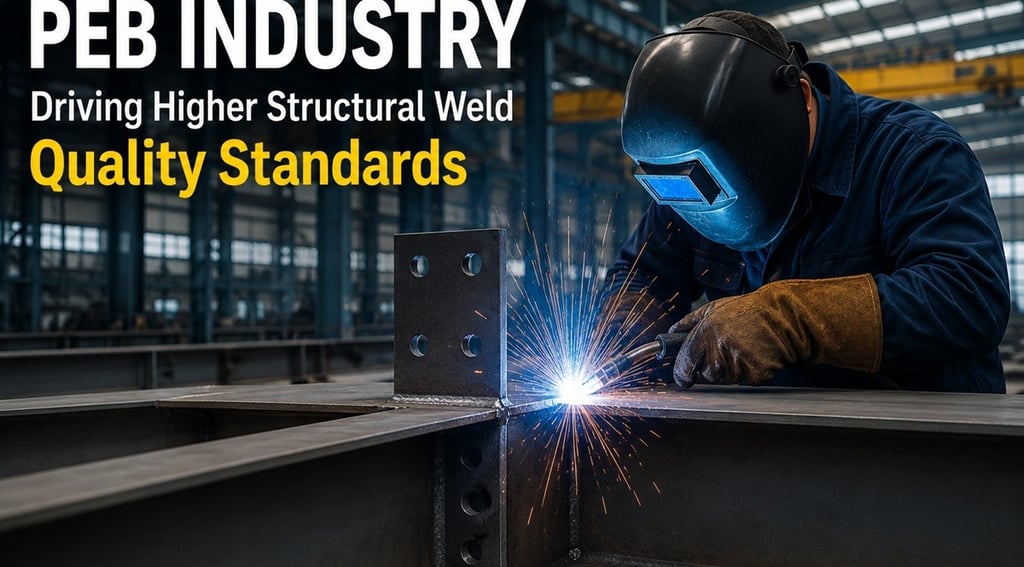
Pre-engineered buildings were once considered a fast and economical alternative to conventional construction, a sector where speed took priority over precision. That perception is now obsolete. India's PEB industry is executing factories, warehouses, logistics hubs, aircraft hangars, and power plant structures where the structural integrity demands are identical to conventional steel construction and where weld quality often achieved using flux cored wire is the single most audited variable in fabrication quality control. The industry has raised its own bar. The question for fabricators and procurement teams is whether their welding consumables have kept pace.
Why PEB Fabrication Is More Demanding Than It Looks
A pre-engineered building is not a simple structure. It is a precisely engineered system of primary frames, secondary members, and cladding designed to specific load combinations wind, seismic, live load, and dead load with tolerances that must be maintained from the fabrication shop floor to final erection. Every weld in a PEB primary frame is a structural weld. The column to rafter connection, the haunch joint, the splice plate, the base plate each, carries calculated design loads and must perform to the assumptions in the structural engineer's model. Unlike general fabrication, there is no redundancy buffer. Each member is sized exactly. A weld that underperforms is not compensated for by adjacent structure it becomes the weak point of the entire bay.
This is why India's leading PEB manufacturers, including facilities supplying to infrastructure, defence, aviation, and industrial clients, now operate with formal welding quality management systems, qualified WPS documentation, and strict consumable approval protocols often working closely with reliable flux cored wire suppliers to ensure consistent weld quality and performance.
What "Structural Weld Quality" Means in a PEContext
For PEB fabricators, structural weld quality is defined by three non negotiable performance pillars:
Mechanical Performance
Weld metal yield strength must match or exceed the parent steel typically IS 2062 Grade E250 to E450 or equivalent high strength structural grades
Charpy impact toughness requirements apply at joints in seismic zones or cold climate applications
Full penetration welds at primary connections must achieve 100% joint efficiency verified through ultrasonic testing (UT) or radiographic testing (RT) per IS 7307 or AWS D1.1
Dimensional and Geometric Consistency
PEB frames are fabricated to tight dimensional tolerances; weld distortion from excessive heat input or incorrect consumable selection adds rework time and cost
Consistent bead geometry critical for web to flange fillet welds on built up sections, which are the backbone of every PEB rafter and column
Productivity and Deposition Rate
PEB fabrication is volume driven; a consumable that slows deposition rate or increases inter pass cleaning time directly impacts shop throughput and delivery schedules
Flux cored wire (FCAW) has become the preferred process for many PEB fabricators precisely because it combines high deposition rates with the mechanical properties required for structural certification
The Shift Toward High Strength Steels in PEB
One of the most significant trends reshaping weld quality requirements in India's PEB sector is the increasing adoption of high strength structural steels (E350 and E410 grades under IS 2062), and imported equivalents in the S355 to S460 range driven by the need to reduce structural weight while maintaining load capacity.
High strength steels change the welding equation significantly:
Preheat requirements increase as carbon equivalent (CE) values rise, failure to preheat correctly on thicker sections causes heat affected zone (HAZ) cracking
Low hydrogen consumables become mandatory, not optional hydrogen induced cracking (HIC) risk is substantially higher in high strength, high restraint joints
Matching strength consumables must be specified using a standard mild steel wire on E410 grade steel creates an undermatched weld that fails load calculations
This is where consumable selection becomes a structural engineering decision, not just a procurement decision. The welding wire specified must be matched to the steel grade, the joint configuration, the preheat regime, and the post weld inspection standard all documented in the WPS.
The Role of Flux Cored Wire in Modern PEB Fabrication
The adoption of flux cored arc welding (FCAW) in PEB fabrication shops has accelerated over the past decade, and for good reason. Compared to manual metal arc (MMA/SMAW) welding, FCAW delivers:
Deposition rates 3 to 4 times higher on fillet and groove welds critical for web to flange welds on long built up sections
All position welding capability important for connection plates, stiffeners, and base plate joints that cannot always be positioned for flat welding
Consistent mechanical properties modern low alloy flux cored wire formulations deliver certified Charpy values and tensile strength for structural applications
Reduced post weld cleaning compared to submerged arc welding (SAW) on shorter weld runs
For butt welds and long continuous runs on heavy flange plates, SAW wire remains the preferred process delivering the highest deposition rates, excellent fusion, and low hydrogen deposits on thick sections.
The choice between FCAW and SAW in a PEB shop is a process engineering decision that directly impacts cost per metre of weld, quality consistency, and throughput. Both require consumables with certified mechanical properties and documented approval for structural use.
Where Weld Quality Failures Actually Happen in PEB Fabrication
Understanding the failure modes helps procurement and quality teams target their controls correctly. In PEB fabrication, the most common weld quality issues arise from:
Incorrect consumable selection for the steel grade
Using standard ER70S 6 MIG wire on E350 or E410 steel creates strength undermatching at critical connections. This is not always caught visually it requires proper WPS documentation and consumable certification review.
Inconsistent hydrogen control on thick section welds
Base plate and splice plate welds on column sections often involve plate thicknesses of 20mm to 50mm or more. Without low hydrogen consumables and correct preheat, delayed hydrogen cracking can occur hours or days after welding after visual inspection has passed.
Distortion from incorrect heat input management
Built up sections are particularly vulnerable to web buckling and flange distortion if heat input is not controlled. The right flux cored wire selection matched to wire diameter, travel speed, and voltage parameters in the WPS is the primary control mechanism.
Inadequate fusion at root passes on full penetration joints
Column to rafter moment connections require full penetration welds. Inadequate root fusion often caused by incorrect joint preparation or wrong consumable for the position is the most serious structural defect in PEB primary frames.
What Procurement Teams Should Demand from Welding Consumable Supplier
For purchase departments and project managers in PEB fabrication, consumable procurement should be treated as a quality input decision, not a commodity purchase. The evaluation criteria:
Structural grade certification
consumable mechanical properties certified per AWS A5 series or EN ISO standards, with test reports available per heat or lot
WPS compatibility
supplier should be able to confirm consumable suitability for your specific parent steel grade, joint type, and thickness range
Low hydrogen designation
H4 or H5 classification per EN ISO 3690 or AWS A5.18/A5.20 for structural grades, documented per supply batch
Productivity data
deposition rate, operating parameters, and all position suitability data to support shop process engineering
Technical support
Does the supplier have the engineering capability to support WPS development, welder qualification, and production troubleshooting?
Ultramet Welds manufactures structural welding consumables including flux cored wire, MIG/MAG welding wire, and SAW wire formulated and certified for the mechanical and productivity demands of PEB and structural steel fabrication.
Key Takeaways
India's PEB sector now demands structural weld quality equivalent to conventional construction fabricators operating without formal WPS documentation and certified consumables are carrying significant quality and liability risk
The shift to high strength steels (E350, E410, S355+) in PEB frames makes low hydrogen welding wire and correct strength matching mandatory, not optional
Flux cored wire is the productivity and quality standard for volume PEB fabrication; SAW wire remains preferred for heavy flange and continuous butt weld runs
The cost of weld rework in a PEB fabrication shop including straightening, re welding, re inspection, and schedule delay consistently, exceeds the cost of specifying the right consumable from the start
Ultramet Welds supplies structural flux cored wire, MIG welding wire, and SAW wire certified for PEB and structural steel fabrication. Whether you are qualifying a new WPS, scaling up production, or upgrading to high strength steel grades, our technical team can support your consumable specification and documentation requirements.
Registered Office
17, Chiman Bagh,
Subhash Marg
Indore (M.P) 452007
India
info@ultrametwelds.com
www.ultrametwelds.com

Plant
D4, Tejas Industrial Park,
Nemawar Road,
Indore (M.P) 452016
India

image from pngtree.com

mig welding wire manufacturer saw flux manufacturer india stainless steel welding wire welding wire suppliers co2 welding wire manufacturers wire welding with argon gas welding manufacturing companies mig welding wire mig wire supplier flux cored wire manufacturerhardfacing welding wirewelding stainless steel with flux core wireflux cored wire suppliersflux cored stainless mig wireflux cored wire manufacturer in indiaflux cored wire manufacturershardfacing welding wirehardfacing flux cored wire
Copyright ©2026 Ultramet Welds Pvt Ltd. All Rights Reserved