
Hybrid FCAW Welding for Heavy & Stainless Steel Fabrication
Explore Ultramet’s hybrid FCAW welding for heavy fabrication and welding stainless steel with flux core wire, boosting productivity, strength, and cost efficiency.
11/28/20255 min read
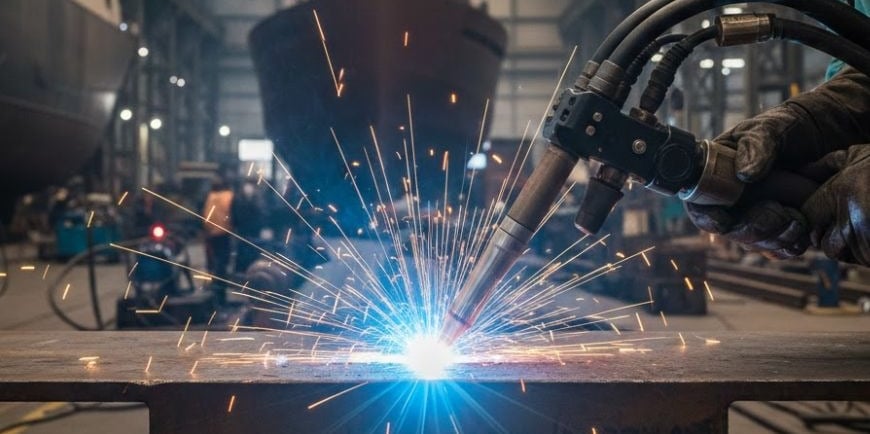
The welding world is changing fast. Options that were once considered high-end or experimental are now regarded as the practical solution for dedicated fabricators. Hybrid welding, where two welding processes work together in the same weld pool, is proving its value on thick plate, demanding joints and tight project timelines.
For Ultramet Welds, this is a big opportunity. Flux-cored arc welding FCAW is no longer just the tough, reliable option on the shop floor. It is a key part of the most advanced welding setups being used in shipyards, bridge projects, and heavy engineering.
What Hybrid Welding with FCAW Really Means
Hybrid welding, in simple terms, is about pairing two processes so that one covers the weaknesses of the other. In most of the work being done today, that means combining.
a laser for deep, focused penetration at high speed
an arc process like FCAW or GMAW to provide filler metal, handle gaps and keep the weld pool stable.
When this pairing is done right, the result is better than either process on its own. Multiple reviews show that laser plus arc setups can deliver higher travel speeds, deeper penetration, better tolerance to joint gaps and improved overall efficiency compared with conventional arc welding alone.
FCAW brings extra advantages to this mix. The flux inside the wire helps control weld chemistry and cooling, supports out-of-position welding, and is more forgiving when fit-up is not perfect.
What the Laser plus FCAW Research Actually Shows
Wallerstein and their team conducted an important study on hybrid laser GMAW and laser FCAW welding for thick structural steel, which is particularly valuable for those working in heavy fabrication. The research examined various gases and filler metals, providing clear insights.
Flux cored wires in hybrid laser FCAW gave deeper penetration and a better weld metal structure, with more acicular ferrite, which is exactly the kind of structure that improves toughness.
Welds made with flux cored wire had lower hardness than those made with solid wire, which reduces the risk of brittle failure in service.
Because the arc and the flux cored wire contribute so much, good welds were achieved with less laser power than when using solid wire, which directly translates into lower energy costs and more efficient production.
At the same time, broader reviews of laser arc hybrid welding show the same pattern repeatedly higher productivity on thick plate, less distortion due to lower total heat input and strong suitability for shipbuilding and heavy steel structures.
Real Life Proof in Shipbuilding and Heavy Steel
This is not just lab data. There are real projects already running on these principles.
Studies on laser hybrid butt welding of large thickness naval steel show that thick plates can be joined in a single pass or just a few passes, while still meeting toughness and quality requirements for demanding marine service. Technical work from shipbuilding groups reports that laser plus arc hybrid welding can slash welding time and improve dimensional control compared with standard multi-pass arc welding.
For owners and project managers, this means:
fewer passes per joint
less heat going into the structure.
smaller distortion problems and fewer straightening operations
shorter schedules and lower labour costs
These same benefits are directly relevant to bridges, offshore structures, heavy machinery, and energy projects, where FCAW is already a familiar process.
Why FCAW is Such a Good Fit for Hybrid
The case for FCAW in hybrid setups is straightforward and backed by data.
It continuously feeds filler metal into the weld pool, filling the laser keyhole and ensuring complete fusion.
It copes well with joint gaps and misalignment, which are common in real-world fabrication.
Its flux system helps control weld chemistry and cooling, encouraging tough microstructures and avoiding overly hard weld metal.
Separate work on Fe Mo B C hardfacing alloys shows that FCAW can be tuned to deliver both wear resistance and toughness when the consumable design is right.
In other words, when FCAW is built into a hybrid configuration, you get the speed and penetration of the laser plus the deposition rate, metallurgical control, and forgiveness of flux cored wire.
What This Means: Speaking Directly to Your Fabrication Challenges
At Ultramet Welds, we understand the pressures you face. Your customers demand faster delivery. Quality standards keep rising. Material costs are climbing. You need solutions that work better and smarter.
That is where hybrid welding comes in. And that is where Ultramet's flux-cored wires become your competitive edge.
The Speed and Efficiency Your Projects Demand
When you combine laser and arc processes, you get something neither can deliver alone. Higher speeds. Deeper penetration on thick plate. Lower total heat input, which means less distortion and fewer straightening operations.
Think about what this means on your shop floor. Joints that used to take 10 or 15 passes now take 2 or 3. Your welding times drop. Your schedule accelerates. Your labour costs fall. Your dimensional accuracy improves because there is less heat warping the steel.
Ultramet wires are engineered to maximize these benefits. Our flux cored formulations work seamlessly in hybrid laser FCAW cells, capturing every advantage the process offers.
The Toughness and Reliability Your Customers Expect
You know the cost of a weld failure in service. A crack in a ship hull. A fracture in a bridge joint. A leak in a pressure vessel. The financial and reputational damage can be enormous.
Flux-cored wires in hybrid laser FCAW setups deliver superior weld metal toughness compared with solid wires. The weld metal shows more acicular ferrite, lower hardness, and better resistance to brittle fracture.
With Ultramet wires, you get this toughness advantage built in. Our consumables are formulated to produce the microstructures that matter. Your welds perform better. Your warranty claims drop. Your reputation grows.
The Cost Control You Need to Stay Competitive
Here is a hard reality. Because flux-cored wire contributes so much to the hybrid weld, you can achieve acceptable quality with lower laser power compared with solid wire. That means lower energy consumption. Lower equipment wear. Lower operational cost per.
Ultramet wires help you hit these targets consistently.
Proven Performance in the Work You Do
You may be fabricating thick naval steels for shipyards. Building major bridge sections. Constructing offshore platforms. Working on heavy machinery for mining or energy.
Hybrid laser FCAW welding has demonstrated its effectiveness across each of these industries. Thick naval steels. Large ship structures. Demanding infrastructure. These are exactly the applications where Ultramet's FCAW wires excel.
Ultramet is simply making sure your wire is ready for the best processes your industry has available.
Engineered for Your Specific Challenges
One size does not fit all in welding. Whether you need outstanding wear resistance for hardfacing, extreme toughness for critical structures or high deposition for speed, we can engineer the consumable to match.
That is what sets Ultramet apart. We do not just sell wire. We solve problems.
Working with thick stainless for corrosion resistance? We have FCAW formulations for that. Running hybrid setups on high-strength steels? We have wires engineered for that too. Need maximum deposition on positional work? Our range covers it.
The Ultramet Commitment
When you choose Ultramet Welds, you are not just buying consumables. You are choosing a partner who understands your market, respects your constraints, and delivers wires that make your operation faster, stronger, and more profitable.
Our wires are ready for laser plus FCAW hybrid cells. Ready for advanced GMAW FCAW combinations. Ready for the automated lines where every minute and every defect matters.
Ultramet Welds. Powering stronger foundations, one weld at a time.
If you are running hybrid welding setups or evaluating the move to hybrid, connect with us. Our technical team can walk through your specific application, show you how Ultramet wires perform in your process and help you capture the efficiency, and quality gains your projects need.
The evolution of hybrid technology is redefining welding stainless steel with flux core wire, offering higher deposition rates, better fusion, and superior structural integrity. It allows fabricators to meet strict quality standards while reducing overall production time.
Because at Ultramet, we do not just follow industry trends. We enable them.


Get in Touch with Ultramet Welds
If you’re looking for high-quality hardfacing welding wire or hardfacing flux-cored wire, Ultramet Welds offers the right solution backed by technical expertise and proven results.
Registered Office
17, Chiman Bagh,
Subhash Marg
Indore (M.P) 452007
India
info@ultrametwelds.com
www.ultrametwelds.com

Plant
D4, Tejas Industrial Park,
Nemawar Road,
Indore (M.P) 452016
India

image from pngtree.com

mig welding wire manufacturer saw flux manufacturer india stainless steel welding wire welding wire suppliers co2 welding wire manufacturers wire welding with argon gas welding manufacturing companies mig welding wire mig wire supplier flux cored wire manufacturerhardfacing welding wirewelding stainless steel with flux core wireflux cored wire suppliersflux cored stainless mig wireflux cored wire manufacturer in indiaflux cored wire manufacturershardfacing welding wirehardfacing flux cored wire
Copyright ©2026 Ultramet Welds Pvt Ltd. All Rights Reserved