
Marine Grade Welding: What the Shipping Industry Can't Afford to Get Wrong
Discover why marine grade welding wire, flux cored wire, and IRS approved consumables are critical for shipbuilding quality, classification compliance, and long term vessel performance.
4/29/20265 min read
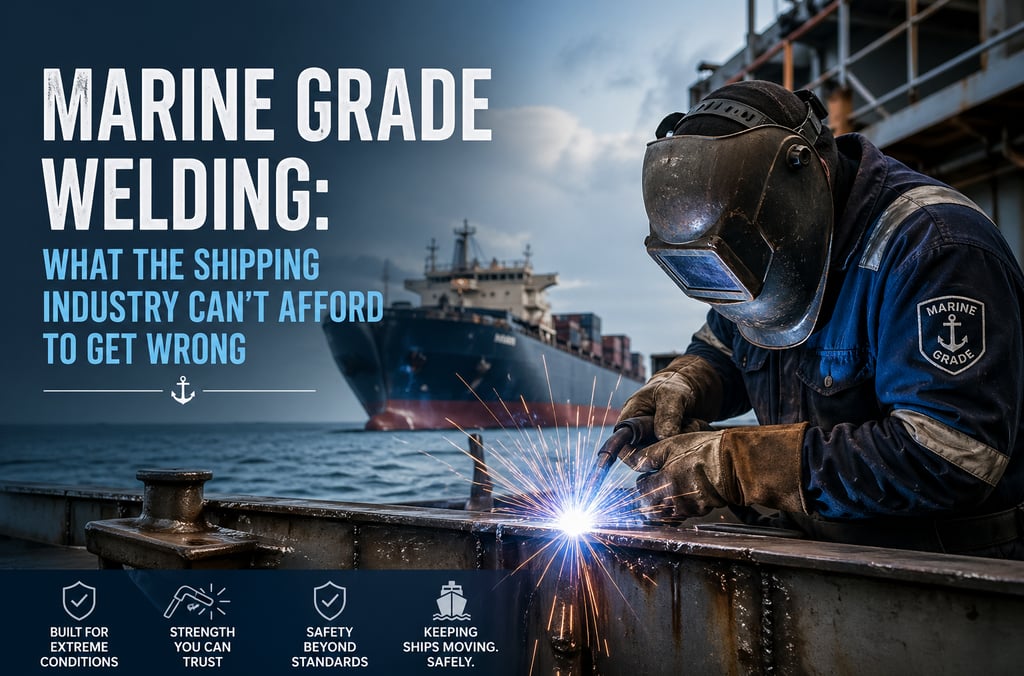
The ocean doesn't forgive poor workmanship. For shipbuilders, fabricators, and marine engineers, a compromised weld isn't just a structural defect; it's a liability that can cost millions in repairs, damage cargo, endanger crew, and disqualify a vessel from international classification. India's shipbuilding sector has matured significantly; today's yards operate with rigorous approval frameworks, classification society oversight, and zero tolerance for non-conformance. The real competitive question is no longer whether your consumable supplier is approved. It's whether they are the right approved supplier for the performance demands of your vessel class.
What "Marine Grade" Actually Means in Welding
The term "marine grade" is not cosmetic. For welding consumables and procedures to qualify for marine construction, they must meet a rigorous set of mechanical and chemical performance benchmarks per IACS W28 and classification society standards:
Charpy impact toughness at sub-zero temperatures (typically 20°C to 40°C) to prevent brittle fracture in hull structures and offshore components
Yield and tensile strength matching or exceeding parent steel - common marine structural grades include AH36, DH36, and EH36 per IACS unified requirements
Low diffusible hydrogen levels classified as H5 (≤5 ml/100g of deposited metal per EN ISO 3690) for critical structural welds, essential to prevent hydrogen-induced cracking (HIC)
Corrosion-resistant weld deposits in zones exposed to seawater, saline atmosphere, or condensation cycling
Every approved supplier on a shipyard's vendor list clears this baseline. What separates good procurement from great procurement is understanding which approved consumables deliver the best mechanical performance, consistency, and technical support for your specific application, hull plating, structural members, pressure vessels, or pipe systems.
The Marine Environment Is Uniquely Brutal
Steel structures on a vessel face a combination of stressors that almost no other industrial environment replicates:
Saltwater corrosion that attacks weld heat-affected zones (HAZ) faster than the base metal
Dynamic cyclic loads from wave action, cargo shifts, and engine vibration, demanding welds with high fatigue resistance
Temperature extremes from sub-zero ocean conditions to engine room heat exceeding 300°C
Constant humidity and condensation, accelerating crevice corrosion at weld toes and root passes
A welding wire that technically meets approval criteria can still underperform if its alloy formulation, hydrogen consistency, or mechanical property margins are at the lower end of the specification window. Approval is the entry ticket. Performance is what delivers a 25-year service life instead of a 10-year one.
Corrosion Resistance: It Starts at the Weld
In marine fabrication, corrosion resistance isn't just about the steel grade it's about the chemical compatibility between the base metal, the weld metal, and the protective coating system. A weld deposit with improper alloying creates galvanic potential differences at the weld interface, making the joint a corrosion initiation point.
High-performance marine-grade welding consumables are formulated to:
Match or exceed the corrosion resistance of AH36, DH36, or EH36 shipbuilding steel
Deliver low diffusible hydrogen levels (H5 classification per EN ISO 3690) consistently across production batches, not just in qualification test conditions
Maintain notch toughness at sub-zero temperatures as required under IACS W28 and classification society approval frameworks
Batch to batch consistency is what distinguishes a reliable welding wire manufacturer in India from one that simply holds an approval certificate. In high-volume shipbuilding production, variability in consumable performance is where quality failures originate.
Weld Integrity Under Dynamic Loads
Ships flex. Every weld in the hull, deck plating, bulkheads, and superstructure must withstand millions of low cycle fatigue events over its service life. Critical factors for fatigue performance include:
Full penetration welds at structural joints with proper root fusion verified through radiographic testing (RT) or ultrasonic inspection (UT)
Controlled heat input during welding to minimise distortion and residual stress is a key parameter in any qualified welding procedure specification (WPS)
Weld profile geometry - undercuts, overlap, and irregular bead profiles are fatigue crack initiation sites under dynamic loading
Notch toughness - low alloy flux cored wire must be qualified to deliver verified Charpy impact values at the design temperature per IACS requirements
The WPS defines the parameters. The consumable must reliably deliver the properties that the WPS qualification demonstrated every weld, every shift, across the full production run.
Compliance with Classification Societies: Lloyd's, DNV, and Beyond
India's leading shipyards are fully aligned with the approval frameworks of Lloyd's Register (LR), DNV, Bureau Veritas (BV), and other IACS member societies. Compliance is standard practice. What project heads and procurement teams increasingly focus on is how well a consumable performs within those approved parameters, especially on complex joints, thick plate sections, and high-restraint configurations where the margin between pass and fail is narrow.
Key areas where consumable quality makes a measurable difference:
Consistent Charpy values across production heats, not just qualification specimens
Stable arc characteristics with flux-cored wire for out-of-position welding on complex hull geometry
Traceability and documentation quality - lot level mill test certificates, hydrogen test reports, and approval certificates readily available for survey
Technical responsiveness - a supplier whose engineering team can support WPS development, welder qualification, and non-conformance resolution
These are the differentiators that determine project schedule and survey outcomes at the most demanding yards.
Why IRS Approval Remains the Foundation for Indian Shipbuilders
The Indian Register of Shipping (IRS) is India's national classification society, a full IACS member, and the governing authority for vessels built, repaired, or classed in India. Every serious marine fabricator in India operates within this framework as a matter of course.
What matters for procurement teams is not simply that a supplier holds IRS approval, it's what that approval covers and how current it is:
Scope of approval - does the certificate cover the specific consumable grades, diameters, and processes required for your project?
Renewal and audit status - is the approval current and actively maintained, with no lapses or conditional findings?
Multi society approval - for export orders or vessels classed under LR, DNV, or BV, does the supplier hold parallel approvals that avoid requalification costs?
Public sector eligibility - yards such as MDL, GRSE, and Cochin Shipyard require documented approval chains; a supplier with clean, comprehensive IRS certification simplifies tender submission and material clearance
Ultramet Welds supplies marine-grade flux-cored wire with the classification approvals, documentation standards, and technical support that India's top shipyards demand.
The Procurement Decision That Defines Project Performance
In marine fabrication, the welding consumable is rarely the largest line item in a project budget; it has an outsized influence on project outcomes. The cost of a weld rework, including NDT, grinding, re-welding, re-inspection, and schedule delay, can be 10 to 20 times the cost of the consumable that caused it.
When benchmarking approved welding wire suppliers in India for your next marine project, consider:
Approval scope and currency - IRS, LR, DNV, BV, ABS certificates covering your required grades and processes
Lot-level mill test certificates with full chemical and mechanical property data for every supply batch
H5 diffusible hydrogen certification per EN ISO 3690 for structural hull grades
Production consistency data - ask for multi-batch mechanical property records, not just qualification test reports
Technical support capability, WPS development, welder qualification assistance, and on-site troubleshooting when it matter
Key Takeaways
"Marine grade" is a precise performance specification; approved welding consumables must meet Charpy, hydrogen, strength, and corrosion criteria specific to marine service per IACS W28
India's shipbuilding sector operates within rigorous approval frameworks; the competitive edge lies in choosing approved suppliers who deliver consistent performance across production volumes
IRS approval scope, currency, and documentation quality are the critical procurement variables not just whether approval exists
Batch-to-batch consistency in low hydrogen welding wire is where long-term structural reliability is won or lost
The right welding wire manufacturer in India brings classification approvals, technical support, and production-grade reliability, not just a certificate
Ultramet Welds supplies marine-grade flux-cored wire with the classification approvals and technical documentation that India's top shipyards rely on. Speak to our team about your vessel class, consumable specifications, and approval requirements.
Visit www.ultrametwelds.com | Request approval certificates and product datasheets today.
Registered Office
17, Chiman Bagh,
Subhash Marg
Indore (M.P) 452007
India
info@ultrametwelds.com
www.ultrametwelds.com

Plant
D4, Tejas Industrial Park,
Nemawar Road,
Indore (M.P) 452016
India

image from pngtree.com

mig welding wire manufacturer saw flux manufacturer india stainless steel welding wire welding wire suppliers co2 welding wire manufacturers wire welding with argon gas welding manufacturing companies mig welding wire mig wire supplier flux cored wire manufacturerhardfacing welding wirewelding stainless steel with flux core wireflux cored wire suppliersflux cored stainless mig wireflux cored wire manufacturer in indiaflux cored wire manufacturershardfacing welding wirehardfacing flux cored wire
Copyright ©2026 Ultramet Welds Pvt Ltd. All Rights Reserved