
Welding Challenges in Boiler Manufacturing | High Performance Welding Consumables | Ultramet Welds
Discover the 5 most critical welding challenges in boiler manufacturing and how the right welding wire, flux cored wire, and low hydrogen consumables solve them for long term pressure vessel performance.
6/11/20267 min read
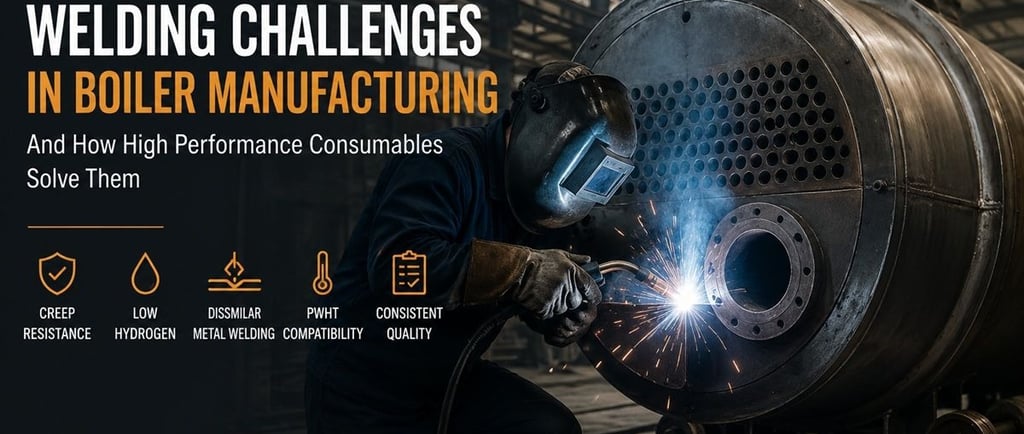
Boiler manufacturing is one of the most technically demanding welding environments in heavy industry. Every weld on a pressure vessel is a safety-critical joint that operates under sustained heat, pressure, and thermal cycling for decades. There is no margin for weld defects, and there is no cosmetic fix for a failed pressure boundary joint. The consequences of a weld failure in a boiler are not measured in rework costs alone, they are measured in plant shutdowns, regulatory action, and in the most serious cases, catastrophic structural failure.
India's boiler manufacturing sector, supplying to power generation, process industries, refineries, and chemical plants, operates under some of the strictest fabrication standards in the world, including IBR (Indian Boiler Regulations), ASME Section I and Section IX, and EN 12952/12953. Within this framework, welding consumable selection is not a procurement variable. It is a design and compliance decision. High-quality flux cored wire plays a crucial role in meeting these stringent fabrication and performance requirements.
Here are the five most critical welding challenges boiler fabricators face, and how high-performance consumables, including FCW, address each one.
Challenge 4: Weld Quality Consistency Across High Volume Tube to Tube Sheet Joints
The Problem
A single industrial boiler can contain thousands of tube-to-tube sheet joints each one a pressure boundary weld, each one subject to IBR or ASME inspection, and each one requiring consistent fusion, penetration, and mechanical properties. Manual SMAW welding of these joints is inherently variable dependent on individual welder skill, fatigue, and position. Inconsistency across a tube sheet with hundreds or thousands of joints creates NDT failures, rework, and schedule overruns that compound across the fabrication programme.
The Solution
Orbital TIG welding with qualified TIG wire (GTAW filler) has become the standard for tube-to-tube sheet joints in quality boiler fabrication shops delivering repeatable, automated weld profiles with minimal variation. The consumable requirements for orbital TIG applications include:
Precise diameter tolerances orbital equipment is sensitive to wire diameter variation; out of tolerance wire causes arc instability and inconsistent penetration
Clean, oxide free wire surface contamination causes porosity and inclusions in the thin wall tube joints
Certified mechanical properties matching the tube and tube sheet material combination
For shops using semi-automatic FCAW or GMAW processes on larger nozzle and stub end joints, consistent wire chemistry and feedability are equally critical arc instability from poor wire surface quality or inconsistent cast and helix causes the same defect profile as manual variation.
Challenge 2: Hydrogen Induced Cracking in Thick Section Pressure Parts
The Problem
Boiler drums, thick walled headers, and tube sheet welds involve plate and forging thicknesses often exceeding 50mm to 100mm. In high restraint joints of this thickness, diffusible hydrogen in the weld metal migrates to regions of high residual stress during cooling and can cause delayed hydrogen induced cracking (HIC) hours or even days after welding is complete. By the time the crack manifests, the component may have already passed visual and dimensional inspection, creating a hidden defect that only NDT will detect at significant cost and schedule impact.
The Solution
Low hydrogen welding consumables classified H4 (≤4 ml/100g) or H5 (≤5 ml/100g) per EN ISO 3690, combined with correct preheat and interpass temperature control are the primary engineering controls for HIC prevention in heavy section boiler fabrication.
For boiler drum and header welds, procurement teams should specify:
SAW wire and flux combinations qualified for low diffusible hydrogen deposits on thick section carbon and low alloy steel
Basic coated electrodes (SMAW) with verified H4 or H5 hydrogen ratings for manual root and fill passes
FCAW consumables with low hydrogen designators for semi-automatic welding of nozzle and attachment welds
Correct storage and handling of low hydrogen consumables, including electrode drying protocols and wire spool sealing is equally important. A consumable that leaves the manufacturer at H4 but absorbs moisture on the shop floor defeats the purpose entirely.
Challenge 2: Hydrogen Induced Cracking in Thick Section Pressure Parts
The Problem
Boiler drums, thick walled headers, and tube sheet welds involve plate and forging thicknesses often exceeding 50mm to 100mm. In high restraint joints of this thickness, diffusible hydrogen in the weld metal migrates to regions of high residual stress during cooling and can cause delayed hydrogen induced cracking (HIC) hours or even days after welding is complete. By the time the crack manifests, the component may have already passed visual and dimensional inspection, creating a hidden defect that only NDT will detect at significant cost and schedule impact.
The Solution
Orbital TIG welding with qualified TIG wire (GTAW filler) has become the standard for tube-to-tube sheet joints in quality boiler fabrication shops delivering repeatable, automated weld profiles with minimal variation. The consumable requirements for orbital TIG applications include:
Precise diameter tolerances orbital equipment is sensitive to wire diameter variation; out of tolerance wire causes arc instability and inconsistent penetration
Clean, oxide free wire surface contamination causes porosity and inclusions in the thin wall tube joints
Certified mechanical properties matching the tube and tube sheet material combination
For shops using semi-automatic FCAW or GMAW processes on larger nozzle and stub end joints, consistent wire chemistry and feedability are equally critical arc instability from poor wire surface quality or inconsistent cast and helix causes the same defect profile as manual variation.
Challenge 3: Dissimilar Metal Welding at Material Transition Joints
The Problem
Modern boiler designs frequently require welding of dissimilar material combinations, carbon steel to low alloy steel, P91 to P22, austenitic stainless steel to ferritic steel, or weld overlay of corrosion resistant alloys onto carbon steel pressure parts. Each of these combinations presents unique metallurgical challenges:
Differential thermal expansion causing stress concentration at the fusion boundary under thermal cycling
Carbon migration from lower alloy to higher alloy steel at elevated service temperatures, degrading the lower alloy side
Dilution effects from the base materials changing the weld metal composition and properties
The Solution
Dissimilar metal welds require consumables specifically selected, and in many cases specifically qualified, for the combination at hand. Common solutions include:
ENiCrFe type (Inconel type) consumables for ferritic to austenitic transitions in high temperature service, providing a ductile buffer that accommodates differential expansion
ER309L / E309LT1 stainless consumables for overlaying carbon steel pressure parts with corrosion resistant surfaces in waste heat and process boilers
Buttering techniques with qualified transition consumables before final joining, as required under ASME Section IX QW 283
This is where the technical capability of the welding consumable supplier becomes critical, not just product supply, but the engineering knowledge to recommend and document the correct consumable for each dissimilar joint in the WPS.
Challenge 4: Weld Quality Consistency Across High Volume Tube to Tube Sheet Joints
The Problem
A single industrial boiler can contain thousands of tube-to-tube sheet joints each one a pressure boundary weld, each one subject to IBR or ASME inspection, and each one requiring consistent fusion, penetration, and mechanical properties. Manual SMAW welding of these joints is inherently variable dependent on individual welder skill, fatigue, and position. Inconsistency across a tube sheet with hundreds or thousands of joints creates NDT failures, rework, and schedule overruns that compound across the fabrication programmed.
Differential thermal expansion causing stress concentration at the fusion boundary under thermal cycling
Carbon migration from lower alloy to higher alloy steel at elevated service temperatures, degrading the lower alloy side
Dilution effects from the base materials changing the weld metal composition and properties
The Solution
Orbital TIG welding with qualified TIG wire (GTAW filler) has become the standard for tube-to-tube sheet joints in quality boiler fabrication shops delivering repeatable, automated weld profiles with minimal variation. The consumable requirements for orbital TIG applications include:
Precise diameter tolerances orbital equipment is sensitive to wire diameter variation; out of tolerance wire causes arc instability and inconsistent penetration
Clean, oxide free wire surface contamination causes porosity and inclusions in the thin wall tube joints
Certified mechanical properties matching the tube and tube sheet material combination
For shops using semi-automatic FCAW or GMAW processes on larger nozzle and stub end joints, consistent wire chemistry and feedability are equally critical arc instability from poor wire surface quality or inconsistent cast and helix causes the same defect profile as manual variation.
Challenge 5: Post Weld Heat Treatment (PWHT) Compatibility
The Problem
IBR and ASME Section I mandate post weld heat treatment for the majority of boiler pressure part welds particularly, on carbon steel above specified thickness thresholds and on all Cr Mo alloy steel welds. PWHT at temperatures typically between 600°C and 760°C (depending on material) stress relieves the weld and HAZ, reduces hardness, and improves toughness. However, if the welding consumable is not formulated for PWHT compatibility, the heat treatment cycle can degrade weld metal properties, reducing toughness below the minimum required values or causing temper embrittlement in certain alloy compositions.
The Solution
Consumables specified for boiler applications must be qualified with mechanical test results in the post weld heat treated condition, not just in the as welded condition. This is a specific ASME Section IX and EN ISO requirement that is sometimes overlooked in consumable procurement.
Key requirements:
PWHT qualified PQR data procedure qualification records must include mechanical tests (tensile, Charpy, hardness) conducted after PWHT at the specified holding temperature and time
Alloy formulation for PWHT stability consumables with controlled manganese, silicon, and microalloying additions maintain toughness through PWHT without embrittlement
Consistency between qualification and production heats the production supply lot must match the chemistry of the qualification lot within the allowable variation in the approved WPS
This is why lot level chemical and mechanical certification from the welding wire manufacturer is not a documentation formality, it is the traceability link that validates the production weld against the qualified procedure.
What Boiler Fabricators Should Demand from a Welding Consumable Supplier
The welding consumable supplier for a boiler manufacturer is not simply a vendor they are a technical partner in a safety critical manufacturing process. The minimum requirements:
IBR and ASME Section II Part C compliance consumables with certified chemical and mechanical data conforming to relevant SFA specifications (SFA 5.1, 5.5, 5.17, 5.18, 5.23, 5.28 as applicable)
Lot level mill test certificates chemical analysis and mechanical properties for every production lot supplied, not just type approval data
PWHT condition mechanical data Charpy and tensile values after PWHT at the customer's specified parameters
Low hydrogen certification H4 or H5 per EN ISO 3690, tested per production lot
Cr Mo grade availability P11, P22, and P91 compatible consumables for all relevant welding processes (SMAW, GTAW, FCAW, SAW)
Technical support for WPS qualification engineering capability to advise on consumable selection for dissimilar joints, PWHT compatibility, and preheat requirements
Ultramet Welds manufactures welding consumables for boiler and pressure vessel applications including low alloy flux cored wire and SAW wire and flux combinations with the mechanical certification, traceability, and technical support that IBR and ASME fabrication demands.
Conclusion
Boiler manufacturing demands welding solutions that deliver strength, reliability, and long-term performance under extreme operating conditions. From creep resistance and low hydrogen control to PWHT compatibility and dissimilar metal welding, every challenge requires carefully selected consumables. Choosing high-quality welding wire and flux cored wire is essential for ensuring safety, compliance, and operational efficiency. With certified products, technical expertise, and industry-focused solutions, Ultramet Welds supports boiler manufacturers in meeting stringent fabrication standards while achieving consistent weld quality and dependable performance.
Registered Office
17, Chiman Bagh,
Subhash Marg
Indore (M.P) 452007
India
info@ultrametwelds.com
www.ultrametwelds.com

Plant
D4, Tejas Industrial Park,
Nemawar Road,
Indore (M.P) 452016
India

image from pngtree.com

mig welding wire manufacturer saw flux manufacturer india stainless steel welding wire welding wire suppliers co2 welding wire manufacturers wire welding with argon gas welding manufacturing companies mig welding wire mig wire supplier flux cored wire manufacturerhardfacing welding wirewelding stainless steel with flux core wireflux cored wire suppliersflux cored stainless mig wireflux cored wire manufacturer in indiaflux cored wire manufacturershardfacing welding wirehardfacing flux cored wire
Copyright ©2026 Ultramet Welds Pvt Ltd. All Rights Reserved